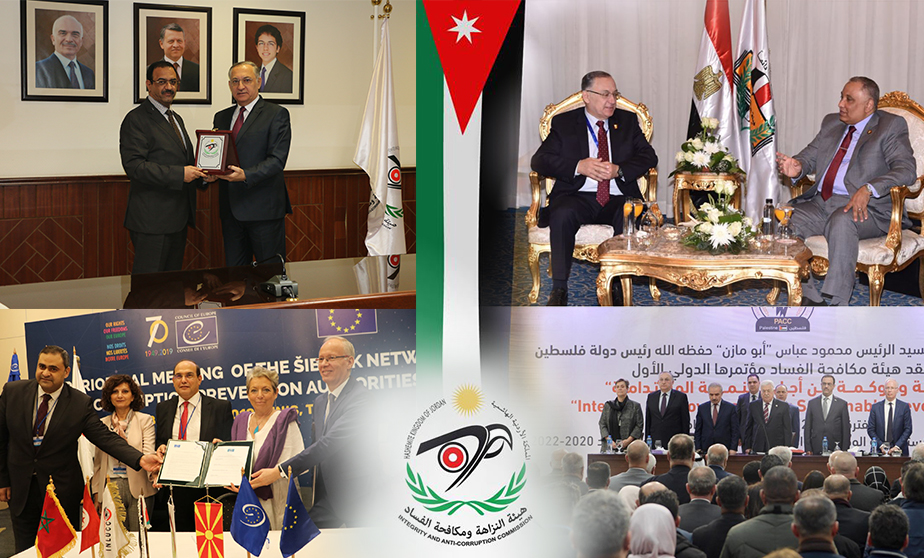
International Cooperation
International cooperation is a key pillar of the work of the Jordan Integrity and Anti-Corruption Commission (JIACC). It plays a vital role in strengthening the Commission's institutional capacity, advancing the national integrity system, and supporting Jordan's efforts to prevent and combat corruption, as well as recover assets derived from corruption-related crimes. These efforts are carried out in line with the United Nations Convention against Corruption (UNCAC), relevant regional and international instruments, and the Hashemite Kingdom of Jordan's commitment to fostering international partnerships and exchanging knowledge and best practices.
JIACC works to establish and strengthen cooperation with international and regional organizations, anti-corruption authorities, and counterpart institutions through the conclusion of Memoranda of Understanding (MoUs), participation in international conferences, meetings, and training programmes, implementation of joint projects, and the exchange of expertise, technical knowledge, and information. These initiatives contribute to enhancing institutional capabilities, building professional competencies, and supporting the continuous development of policies, legislation, and institutional practices.
International cooperation also enables JIACC to benefit from successful international experiences, enhance Jordan's presence in regional and global anti-corruption forums, and support the implementation of the National Integrity and Anti-Corruption Strategy. By promoting transparency, integrity, accountability, and good governance, these partnerships contribute to improving institutional performance and strengthening public confidence in government institutions.
Regional and International Partnerships, Agreements and Memoranda of Understanding
Regional and International Agreements
The Hashemite Kingdom of Jordan has ratified a number of regional and international conventions related to anti-corruption, anti-money laundering, asset recovery, and international cooperation. The most significant of these include:
- United Nations Convention against Illicit Traffic in Narcotic Drugs and Psychotropic Substances (1988).
- International Convention for the Suppression of the Financing of Terrorism (1999).
- United Nations Convention against Transnational Organized Crime (2000).
- United Nations Convention against Corruption (UNCAC) (2003).
- Arab Convention against Corruption (2010), under the auspices of the General Secretariat of the League of Arab States.
- Makkah Al-Mukarramah Convention for the Member States of the Organization of Islamic Cooperation (OIC) on Cooperation in the Enforcement of Anti-Corruption Laws (2024).
- Memberships
The Commission actively participates in a number of regional and international networks and initiatives that promote integrity, anti-corruption, international cooperation, and institutional capacity building, including:
- International Anti-Corruption Academy (IACA).
- Stolen Asset Recovery Initiative (StAR), launched in 2007 by the United Nations Office on Drugs and Crime (UNODC) and the World Bank to strengthen the capacity of law enforcement authorities in recovering stolen assets.
- Arab Anti-Corruption and Integrity Network (ACINET) – Jordan joined the network and chaired it in 2008.
- International Ombudsman Institute (IOI) – Member since 2009.
- Association of Mediterranean Ombudsmen (AOM) – Member since 2011.
- Organization of Islamic Cooperation Ombudsman Association (OICOA) – Member since 2014.
- Network of Corruption Prevention Authorities (NCPA) – Member since 2019.
- Association of Ombudsman Authorities of the Organization of Islamic Cooperation (AOA) – Member since 2019.
- Global Judicial Integrity Network (GJIN) – Member since 2020.
- GlobE Network (Global Operational Network of Anti-Corruption Law Enforcement Authorities) – Member since 2021.
- International Association of Anti-Corruption Authorities (IAACA) – Member since 2022.
- Rule of Law Youth Network (RoLYN), launched by the Council of Europe to raise awareness of the links between corruption and environmental degradation and to encourage youth engagement in promoting the rule of law and integrity.
Regional and International Memoranda of Understanding
The Commission has concluded Memoranda of Understanding (MoUs) with several counterpart anti-corruption and oversight institutions, as well as international organizations, to strengthen cooperation, exchange expertise, and promote joint efforts in preventing and combating corruption:
- State of Palestine – Palestinian Anti-Corruption Commission, signed on 14 May 2018.
- Arab Republic of Egypt – Administrative Control Authority (ACA), signed on 15 December 2021.
- Republic of Tunisia – National Anti-Corruption Authority, signed on 17 October 2019.
- Network of Corruption Prevention Authorities (NCPA) – Signed on 16 October 2018.
- United Nations Development Programme (UNDP) – Signed on 9 December 2021.
- Kingdom of Saudi Arabia – Oversight and Anti-Corruption Authority (Nazaha), signed on 21 June 2022.
- Republic of Lithuania – Special Investigation Service (STT), signed on 30 June 2022.
- Republic of Iraq – Federal Commission of Integrity, signed on 25 January 2024.
- Kingdom of Morocco – National Authority for Probity, Prevention and Fight against Corruption, signed on 23 July 2024.
- United Arab Emirates – UAE Accountability Authority, signed on 3 September 2024.
- State of Qatar – Administrative Control and Transparency Authority, signed on 26 November 2024.
- Lebanese Republic – National Anti-Corruption Commission , signed on 26 November 2024.
- Republic of Kazakhstan – Anti-Corruption Agency , signed on 26 November 2024.
Strategic Partnerships
The Jordan Integrity and Anti-Corruption Commission (JIACC) maintains strategic partnerships with a wide range of regional and international organizations to strengthen institutional capacity, enhance international cooperation, and support the implementation of best practices in integrity, transparency, anti-corruption, and good governance. Key partners include:
- European Union (EU).
- Council of Europe (CoE).
- Organisation for Economic Co-operation and Development (OECD).
- World Bank Group.
- European Anti-Fraud Office (OLAF).
- United States Agency for International Development (USAID).
- Office of Inspector General (OIG), United States Agency for International Development (USAID).
- Anti-Corruption and Civil Rights Commission (ACRC), Republic of Korea – counterpart institution.
- Financial Action Task Force (FATF), in cooperation with Jordan's Anti-Money Laundering and Counter Terrorist Financing Unit (AMLU).
- International Criminal Police Organization (INTERPOL).
- Technical Assistance and Information Exchange Instrument (TAIEX) of the European Union, through the organization and follow-up of study visits, expert missions, and technical workshops, in cooperation with the Ministry of Planning and International Cooperation.
- International Monetary Fund (IMF) – Middle East Center for Economics and Finance (Kuwait), through participation in specialized training programmes.
- Support for Improvement in Governance and Management (SIGMA).
- United Nations Development Programme (UNDP) – Continued cooperation with the Regional Office in providing technical assistance and capacity-building support to advance the Sustainable Development Goals (SDGs) through aligning these goals with the Commission's strategy.
- The Hague Academy for Local Governance.
OECD Public Integrity Indicators
Jordan participates in the OECD Public Integrity Indicators (PII) initiative, with the Jordan Integrity and Anti-Corruption Commission serving as the national coordinating authority. In cooperation with the relevant national institutions, the Commission coordinates the collection and validation of official data, reviews the applicable legislative and institutional frameworks, and supports national consultations on the findings. Jordan’s participation currently covers the quality of the strategic framework, accountability of public policymaking, the effectiveness of internal control and risk management, and the integrity of the justice and disciplinary systems. The initiative provides an evidence-based framework for identifying national strengths and opportunities for improvement, supporting institutional reform, and aligning integrity and governance efforts with Jordan’s national priorities, including the Economic Modernisation Vision, the Public Sector Modernisation Roadmap, and the National Integrity and Anti-Corruption Strategy.
Click here to view Jordan's (PII) Profile
Jordan and the United Nations Convention against Corruption (UNCAC)
Overview
The Hashemite Kingdom of Jordan signed the United Nations Convention against Corruption (UNCAC) on 9 December 2003 and ratified it on 24 February 2005, reaffirming its commitment to preventing and combating corruption, promoting integrity, strengthening international cooperation, and facilitating asset recovery. The Jordan Integrity and Anti-Corruption Commission (JIACC) serves as the national authority responsible for coordinating the implementation of the Convention and Jordan's participation in the UNCAC Implementation Review Mechanism (IRM). Jordan is currently undergoing the Second Review Cycle, covering Chapter II (Preventive Measures) and Chapter V (Asset Recovery).
National Anti-Corruption Framework
Jordan has established a comprehensive legal and institutional framework to support the effective implementation of UNCAC. This framework includes the Integrity and Anti-Corruption Law (IACL) and its proposed amendments, the Access to Information Law (amended in 2024), the Government Procurement Regulation No. (8) of 2022 and the Jordan National E-Procurement System (JONEPS), in addition to the Illicit Gains Law, the Anti-Money Laundering and Counter-Terrorism Financing (AML/CFT) Law, and the Beneficial Ownership Register.
Recent Developments
Jordan continues to strengthen its anti-corruption framework through legislative and institutional reforms. Recent developments include amendments to the Access to Information Law, proposed amendments to the Integrity and Anti-Corruption Law to enhance whistleblower and witness protection, the expansion of electronic government procurement through JONEPS, strengthened anti-money laundering measures and beneficial ownership transparency, and the launch of a university-level Master's Programme in Anti-Corruption Studies alongside expanded integrity training for public officials.
International Cooperation
Jordan actively participates in regional and international initiatives that support the implementation of UNCAC. The Commission cooperates closely with the United Nations Office on Drugs and Crime (UNODC), the Organisation for Economic Co-operation and Development (OECD), the Middle East and North Africa Financial Action Task Force (MENAFATF), the Egmont Group of Financial Intelligence Units, and the GlobE Network – Global Operational Network of Anti-Corruption Law Enforcement Authorities. At the national level, implementation of the Convention is supported through close cooperation with the Audit Bureau, the Anti-Money Laundering and Counter Terrorist Financing Unit (AMLU), the Ministry of Finance, the Civil Service and Public Administration Commission, and the Judicial Council.
Transparency and Public Participation
Jordan supports the principles of the UNCAC Review Transparency Pledge, promoting transparency, publication of review outcomes, stakeholder engagement, and civil society participation throughout the implementation process. The Commission also works closely with civil society organizations, academic institutions, and other national partners in implementing the National Integrity and Anti-Corruption Strategy (2026–2030) through awareness programmes, consultations, and integrity initiatives.
Strategic Priorities
The Commission continues to focus on strengthening whistleblower protection, enhancing transparency and proactive disclosure of public information, improving integrity risk management and conflict-of-interest frameworks, expanding digital government services and electronic procurement, and reinforcing international cooperation in mutual legal assistance and asset recovery in line with the objectives of the Convention.
Official Resources
Additional information on Jordan's implementation of the United Nations Convention against Corruption is available through the UNODC Jordan Country Profile, the published Executive Summary of the Second Review Cycle, the Integrity and Anti-Corruption Law, the Access to Information Law, and the National Open Data Portal.
National Focal Point
Ms. Hala Al Shuraiki,Head of the International Cooperation Division
Jordan Integrity and Anti-Corruption Commission (JIACC)
Email: Hala.Shuraiki@jiacc.gov.jo